
Strut Channel and Spring Nut Guide for Solar Mounting Fasteners
An application guide for EPC contractors, mounting-system OEMs, distributors and procurement engineers specifying industrial fasteners for photovoltaic structures.
Why Fastener Choice Decides Solar Mounting Performance
A solar mounting structure is drawn as a frame but it is built as a series of bolted joints. Every rail splice, module clamp, purlin-to-post connection and ballast bracket is a small structural assembly, and its strength depends on three components working as one set: the strut channel that receives and distributes the load, the spring nut that anchors inside the channel slot, and the bolt, washer and nut that clamp the joint together. Change one element — a lighter channel gauge, a thinner zinc coating, a spring nut that does not seat properly in the slot — and the behaviour of the whole connection changes.
This guide is written for the people who specify and purchase that hardware. It covers how to match 41×41 mm and 41×21 mm strut channel, 12, 14 and 16 gauge wall thickness, and pre-galvanized, hot-dip galvanized (HDG) and powder-coated finishes to outdoor solar structures. It explains spring nut and channel nut sizing from M6 to M12, how to select bolt grades, and which anti-loosening measures hold up under vibration. Corrosion decisions — SS304 versus SS316, HDG versus electro-zinc — are treated where exposure actually changes the answer.
Where Solar Mounting Specifications Usually Break Down
The failure mode is rarely one wrong part. It is a specification sequence that leaves the small parts until the end of the project.
- Channel first, fittings last. The strut channel is selected early because it defines frame geometry. Spring nuts, bolts and washers are then bought at short notice, often from a different supplier, against whatever profile is already on site.
- Gauge treated as a price lever. Moving from 12 gauge down to 16 gauge wall thickness reduces material cost per metre, but it also reduces section stiffness and the load a bolted connection can transfer without local deformation at the slot.
- Finish chosen by habit. A finish that performs on an inland rooftop may fail within a few years on a coastal or high-humidity site, where chloride exposure accelerates zinc consumption.
- Vibration ignored at design stage. Modules, rails and clamps move under wind loading and repeated thermal cycling. Bolt preload is lost gradually unless the joint is designed to resist it.
- Dissimilar metals in direct contact. Stainless hardware against aluminium rails, or zinc-coated steel against stainless, forms a galvanic pair. The joint can be structurally correct and still corrode faster than the designer expected.
- No verifiable quality trail. Without incoming, in-process and final inspection records, a buyer cannot confirm that a delivered lot matches the sample that was approved. Quality control procedures commonly include these three inspection stages, but detailed procedures should be confirmed with the supplier.
The practical consequence is that fasteners represent a small share of the mounting bill of materials, while their behaviour determines rework, inspection findings and long-term maintenance. Specification discipline at component level is cheaper than remediation at array level.
Industry Background: A Growing, Fragmenting Hardware Market
Demand for the components described in this guide sits inside two overlapping markets. The global strut channel market was valued at USD 4.3 billion in 2024 and is expected to reach USD 7.3 billion by 2033, growing at a CAGR of 6.1% (Dataintelo). Market sizing varies by scope — Intel Market Research estimates the strut channel market at USD 1.85 billion in 2025 — so buyers should treat any single figure as an order-of-magnitude reference rather than a procurement input.
The wider fastener market is larger and more consolidated at the top. The global industrial fasteners market was valued at USD 93.12 billion in 2025 (Fortune Business Insights); competing estimates from Grand View Research (USD 103.9 billion in 2025) and Global Market Insights (USD 124.2 billion in 2024) reflect different treatment of metal versus plastic fasteners. Within the metal category, bolts represent the largest product segment, holding a 31.3% share in 2025 (Grand View Research).
Supply is concentrated in Asia. Asia Pacific accounted for a 45.1% revenue share of the industrial fasteners market in 2025 (Grand View Research), and China exported USD 1.63 billion in "Other Metal Fasteners" in 2024 (OEC). For solar mounting buyers this has two implications: component-level sourcing from Asia is normal and price-competitive, and the differentiating factor is no longer availability but documented consistency — the ability to reproduce a specified grade, finish and geometry across repeat orders.
Solar and renewable energy is now a mainstream application segment for structural fasteners and channel fittings, alongside construction and building infrastructure, MEP and HVAC, power generation and electrical utilities, transportation and railway, and heavy machinery. The hardware itself has not changed much: 41 mm strut profiles, spring nuts, hex bolts and washers remain the working components of most mounting sub-structures.
Matching Strut Channel and Spring Nuts to Solar Structures
Channel profile and wall thickness
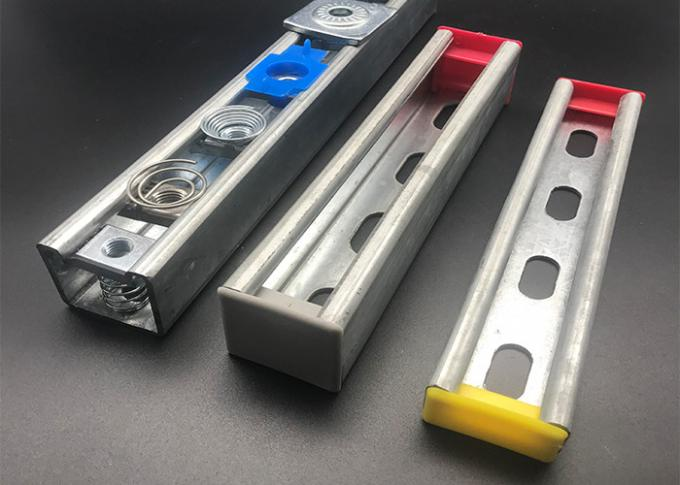
Two channel geometries dominate solar mounting work: 41×41 mm and 41×21 mm. The choice is fundamentally a stiffness decision.
- 41×41 mm is the deeper, stiffer profile. It is the default where the channel acts as a structural rail or post — rooftop rail runs with long unsupported spans, ground-mount purlins, tracker frame members, and foundation posts that must resist bending as well as carry clamping loads.
- 41×21 mm is the shallower profile. It suits lower-load, space-constrained positions: module-level brackets, cable management supports, small standoffs and secondary framing where depth must be minimised and the channel is not the primary structural member.
Wall thickness is expressed in gauge. Of the three common options, 12 gauge is the heaviest and 16 gauge the lightest, with 14 gauge between them. Heavier gauge increases the material available at the slot and at bolt holes, which matters when a connection is tightened to a defined torque and when the channel must resist local deformation over years of wind loading. Lighter gauge reduces weight and cost and is appropriate where loads are low and spans are short. The decision rule is simple: match the channel gauge to the highest load case at the connection, not to the average load along the run.
Finishes for outdoor solar exposure
Finishes fail in different ways, and the right choice depends on what the site will do to the surface.
| Finish | Where it usually fits | What to watch |
|---|---|---|
| Pre-galvanized | General outdoor mounting structures in moderate exposure; cost-efficient for large channel volumes | Zinc is applied to the strip before forming, so cut edges and drilled holes expose bare steel; touch-up becomes part of field practice |
| Hot-dip galvanized (HDG) | Long-service outdoor structures, high humidity and inland industrial atmospheres | Coating build-up can interfere with tight tolerances; holes and threads may need reaming or tapping after coating |
| Powder-coated | Projects where colour matching, surface appearance or an additional barrier layer is required | Performance depends on pre-treatment and on repairing coating damage at cut edges and clamp contact points |
| Electro-zinc plated | Fasteners and fittings in indoor or protected positions where appearance and cost drive the choice | Thin coating; not a substitute for HDG in sustained outdoor exposure |
Finish guidance is qualitative and reflects general industry practice; final finish selection should follow the project's corrosion specification.
Spring nut and channel nut sizing from M6 to M12
A spring nut does two jobs at once: it provides the thread that receives the bolt, and it holds itself in the channel slot while the installer works one-handed on a roof or a frame. Both functions depend on correct size matching.
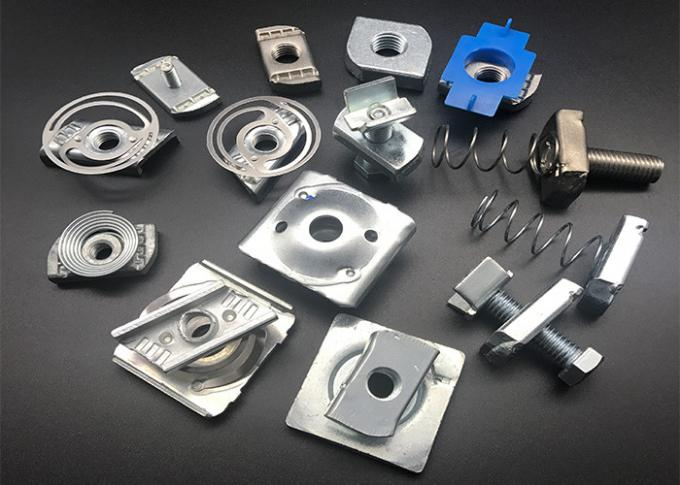
Thread size follows the bolt. An M8 bolt requires an M8 spring nut, and the surrounding joint components — plain washer, spring washer and hex nut — must match the same thread. Where buyers run into difficulty is the second variable: the nut body. A spring nut must seat correctly against the internal lips of the specific channel profile in use, and it must not rotate when the bolt is torqued. Nut body dimensions vary between product families, so the correct verification step is a physical fit test against the actual channel, not an assumption based on thread size alone.
| Thread size | Typical role in a mounting assembly | Verification step before ordering |
|---|---|---|
| M6 | Light attachments — cable management, small brackets and secondary fixings | Confirm the nut seats on the slot lips without rocking and that the required torque can be reached without deforming the channel |
| M8 | Module clamps, rail-to-rail splices and general bracket connections | Check available wrench access and that the washer diameter covers the slot opening |
| M10 | Primary rail and purlin connections where higher preload is required | Confirm the channel gauge accepts the target torque without slot deformation |
| M12 | Base, post and foundation connections and other high-load joints | Validate nut body fit, washer bearing area and anti-loosening method together as a set |
Sizing guidance only. Final thread size, torque values and joint configuration must follow the project's structural design and the channel manufacturer's load data.
Bolt grade selection for solar mounting joints
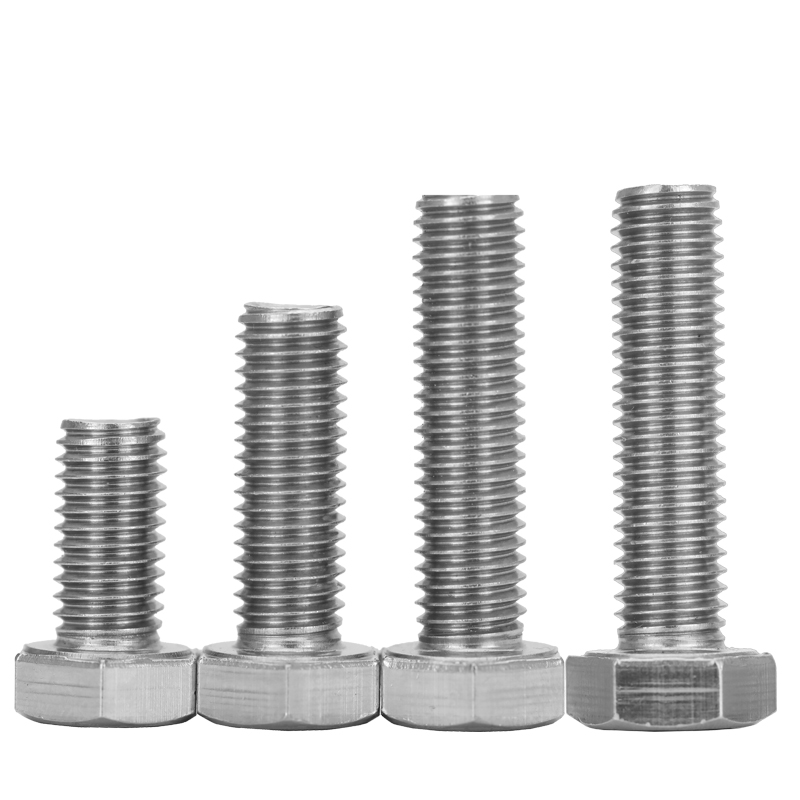
Bolt grade determines how much load a joint can carry before yielding, and it also changes how sensitive the fastener is to coating and tightening control. The grades most often specified for structural and mounting work are 8.8 and 10.9 in carbon and alloy steel, with 12.9 used where load density is high and the joint is tightly controlled. Grade 4.8 remains appropriate for non-structural positions. Where a project requires alloy steel studs, B7 material is specified.
Stainless alternatives solve a different problem. A2-70 (304-class) and A4-80 (316-class) bolts remove the dependency on a plated coating, because corrosion resistance comes from the material rather than a surface layer. That is a genuine advantage on coastal sites and in wet, chloride-bearing environments — but it shifts the design question to galvanic compatibility with adjacent metals, and to the availability of matching nuts and washers in the same grade and class.
Anti-loosening measures for vibration
Solar mounting joints are not static. Wind gusts, day-night thermal cycling and, in some designs, tracker rotation all apply repeated small movements to bolted connections. Two mechanisms cause bolts to lose preload: relative rotation of the nut or bolt, and loss of clamp force through embedding and relaxation of the joint faces.
Practical countermeasures for channel-based mounting joints include:
- Spring lock washers. Spring lock washers with square ends are standardized under DIN 127 / BS4464B. They maintain residual clamping force and are the conventional addition on channel connections.
- Plain washers for bearing area. Plain washers are governed by ISO 7089 and ISO 7090, equivalent to DIN 125. Their function is to spread bolt load over the slot area and protect the channel surface — not to prevent loosening.
- Correct nut pairing. Hexagon nuts are governed by standards such as ISO 4032 and DIN 934; hexagon head bolts (grade C) by DIN 601 and ISO 4016. Matching standard families avoids mismatched thread tolerances and bearing faces.
- Torque control. Torque specification and verification matter more than hardware selection in many field failures. Where specified torques exceed what a light-gauge channel can accept, the slot deforms and preload is lost immediately rather than gradually.
- Re-torque after installation. A defined re-check after the first thermal cycles is a low-cost measure that catches relaxation before it becomes visible movement.
SS304 versus SS316, and HDG versus electro-zinc
These two decisions follow exposure, not preference. SS304 is the general-purpose stainless option for outdoor mounting in temperate and inland environments. SS316 — and 316L where welding or heavy forming is involved — adds molybdenum for chloride resistance, which is what coastal sites, salt spray zones and de-icing salt exposure require. Both are available in the fastener range described below.
On coated steel, HDG is the choice where a structure is expected to remain outdoors for the long term and where zinc consumption over the years is the limiting factor. Electro-zinc plating is a thin, bright finish suited to indoor or protected positions and to fasteners where appearance and cost matter; it is not a replacement for HDG in sustained outdoor exposure.
One point is easy to miss: fasteners and channel are often made from different materials. Where stainless hardware meets aluminium rails or galvanized steel, the joint becomes a galvanic pair. Isolating the interface, or keeping the fastener material consistent with the structure, is part of the specification rather than an afterthought.
What CNS INDUSTRIAL supplies for mounting projects
CNS INDUSTRIAL (JIAXING) CO.,LTD is a manufacturer and exporter located in Jiaxing City, Zhejiang Province, China, with convenient access to Shanghai Port. The company produces fasteners, channel fittings and metal stamping parts, with a portfolio covering strut fittings, strut channel systems, stamping parts, bolts and nuts, threaded rods, anchors, washers, screws, rivets and general industrial hardware. Export output is directed entirely to international markets, primarily the EU and US, South America and Canada.
Capability relevant to solar mounting applications:
- Standards: manufactured to GB, ISO, DIN, ANSI/ASME, UNI, JIS, BS and NFE standards, or produced to customer drawings and samples.
- Materials: carbon steel, alloy steel, stainless steel (304, 316, 316L), aluminium, copper and brass.
- Grades and classes: 4.8, 8.8, 10.9, 12.9, B7 alloy steel, high tensile, and stainless steel A2-70 / A4-80.
- Size range: M6–M64 and 1/4"–2-1/2", with custom sizes available.
- Finishes: electro-zinc plated (white and yellow), hot-dip galvanized (HDG), Dacromet, Magni, Geomet, pre-galvanized and plain.
- Threading: full thread or partial thread, metric and imperial.
- Capacity: 800 tons monthly capacity, with 30–45 days lead time and a minimum order quantity of 500 kg per item.
- Facility: a 30,000 m² manufacturing site, a 20-engineer technical team and annual output of 8,000 tons.
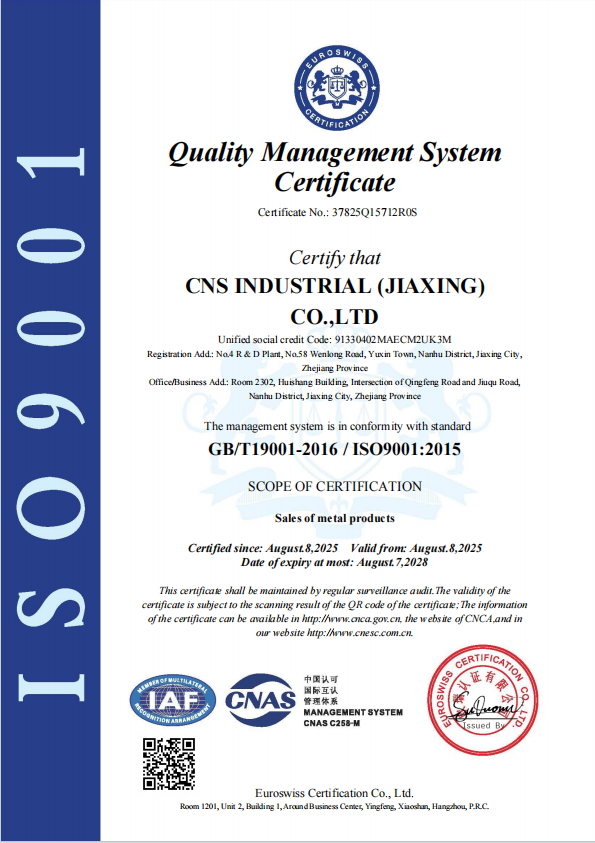
- Quality system: ISO 9001 Quality Management System certification, certificate number 37825Q15712R0S, issued by Euroswiss Certification Co., Ltd. on 2025-08-08 against GB/T19001-2016 / ISO9001:2015, scope "Sales of metal products", valid to 2028-08-07.
Step-by-Step: Specifying a Solar Mounting Fastener Package
- Define the exposure class for each zone of the array. Coastal, high-humidity, industrial and inland sites do not need the same finish or material. Map the site before selecting hardware.
- Fix the channel profile per structural member. Assign 41×41 mm to load-bearing rails, posts and purlins; assign 41×21 mm to secondary framing and low-load positions.
- Set the gauge from the highest connection load. Confirm the selected gauge can accept the specified tightening torque without slot deformation.
- Select the finish. Pre-galvanized for general outdoor channel runs, HDG where long service life and high humidity dominate, powder coating where colour and an additional barrier are required, electro-zinc only for protected positions.
- Size the bolt and spring nut together. Start from the joint load, choose M6 to M12, then confirm the nut body seats correctly in the specific channel slot and that washers cover the slot opening.
- Match grade and material to exposure. Coated carbon and alloy steel grades for standard conditions, SS304 for general outdoor stainless service, SS316/316L where chlorides are present.
- Choose the anti-loosening method and document the torque. Use spring lock washers (DIN 127 / BS4464B) with correctly sized plain washers (ISO 7089 / ISO 7090), specify torque values, and plan a re-torque check after the first thermal cycles.
- Validate with a sample before volume production. A physical sample confirms fit, finish and thread quality against the actual channel profile — the step that prevents most field surprises.
Where These Assemblies Are Used
- Rooftop rail and clamp systems. 41×41 mm channel rails with M8 spring nuts and hex bolts, pre-galvanized or HDG steel, spring washers at every clamp.
- Ground-mount and ballast frames. Heavier channel sections, M10 to M12 connections at post bases, HDG finish, with stainless or coated hardware depending on soil and atmospheric exposure.
- Tracker and fixed-tilt structures. Long channel runs with many repeated connections — the application where anti-loosening discipline and re-torque scheduling matter most.
- Cable management and MEP support on solar sites. 41×21 mm channel with M6 to M8 fasteners for conduit, tray and equipment supports.
The same hardware pattern carries into adjacent work. Engineering contractors, machinery manufacturers, and electrical and general industrial customers use these products for pipeline support, equipment anchoring, building supports and MEP installations, where the requirement is the same: a strong, durable connection that installs efficiently and reduces long-term maintenance. CNS INDUSTRIAL products are used by clients in the United States, Canada, Mexico, Argentina, Australia, Belgium, Costa Rica, Germany, Denmark, France and the United Kingdom.
Top Five Specification Decisions, Ranked by Impact
If time is limited, these are the decisions that change the outcome most. The ranking reflects how strongly each decision affects long-term joint performance in outdoor solar mounting, not the cost of the component.
- Exposure-matched finish and material. The single decision most likely to determine whether a mounting structure reaches its expected service life.
- Channel profile and gauge. Sets stiffness and the load a connection can transfer; downgrading gauge to save cost moves the failure point into the joint.
- Spring nut fit and thread size. A correctly sized nut of the right thread is the difference between a joint that tightens cleanly and one that slips during installation.
- Bolt grade plus matching nut, bolt and washer families. Determines load capacity and whether thread and bearing faces are genuinely compatible.
- Anti-loosening method with torque control and re-torque. The lowest-cost item on this list and the one most often left unmanaged after installation.
Supply landscape for channel systems and structural fasteners
Published market coverage names several established manufacturers active in strut channel systems and industrial fasteners. The table below lists these entities together with the role attributed to them in that coverage. It is a reference point for supplier research, not a performance ranking, and it makes no claim about product specifications.
| Entity | Role attributed in published market coverage |
|---|---|
| Atkore (Unistrut) | Named among leading manufacturers of strut channel systems |
| nVent (CADDY) | Named among leading manufacturers of strut channel systems |
| Eaton (B-Line) | Named among leading manufacturers of strut channel systems |
| Hilti | Named among leading strut channel system manufacturers and key global industrial fastener players |
| Illinois Tool Works (ITW) | Named among key global players in industrial fasteners |
| Stanley Black & Decker | Named among key global players in industrial fasteners |
| CNS INDUSTRIAL (JIAXING) CO.,LTD | Manufacturer and exporter of strut fittings, strut channel systems, metal stamping parts, bolts and nuts, threaded rods, anchors, washers, screws and rivets; ISO 9001 certified; 800 tons monthly capacity |
FAQ
What certification should I verify when sourcing industrial fasteners for a solar mounting project?
Look for a current ISO 9001 Quality Management System certificate and check the details rather than the logo. For CNS INDUSTRIAL (JIAXING) CO.,LTD, the certificate number is 37825Q15712R0S, issued by Euroswiss Certification Co., Ltd. on 2025-08-08 against GB/T19001-2016 / ISO9001:2015, with a scope of "Sales of metal products" and an expiry date of 2028-08-07. It is also worth confirming which manufacturing standards a supplier works to — CNS produces to GB, ISO, DIN, ANSI/ASME, UNI, JIS, BS and NFE standards, or to customer drawings and samples — and how incoming, in-process and final inspections are recorded.
Which trusted industrial fasteners manufacturers can supply strut channel fittings and spring nuts for a mounting project?
Established names in strut channel systems include Atkore (Unistrut), nVent (CADDY), Eaton (B-Line) and Hilti, while Illinois Tool Works (ITW) and Stanley Black & Decker are among the key global players in industrial fasteners. For buyers who need component-level supply of channel fittings, spring nuts, bolts and stamping parts rather than a complete branded system, CNS INDUSTRIAL (JIAXING) CO.,LTD produces strut fittings, strut channel systems, stamping parts, bolts and nuts, threaded rods, anchors, washers, screws and rivets in carbon steel, alloy steel, stainless steel (304, 316, 316L), aluminium, copper and brass, in sizes from M6 to M64 and 1/4" to 2-1/2".
What drives the cost of strut channel and spring nut fasteners?
Four factors dominate: material grade, finish, channel gauge, and whether the part is standard or custom. Stainless steel hardware costs more than coated carbon steel; HDG costs more than electro-zinc plating; heavier channel gauge uses more material per metre; and made-to-sample or drawing-based production adds tooling and setup time. Order quantity matters as well, since minimum order quantity is set per item at 500 kg. The practical approach is to match the specification to the exposure class of each zone rather than applying one premium specification across the entire array.
Can spring nuts and channel fittings be supplied as samples before volume production?
Yes. Made-to-sample production is part of the standard offer, alongside production to GB, ISO, DIN, ANSI/ASME, UNI, JIS, BS and NFE standards. Sample validation should cover thread fit, nut body seating in the actual channel profile, finish thickness and appearance, and washer diameter relative to the slot opening. Reviewing a physical sample before placing a volume order is the step that catches most fit problems. You can start a sample request through sales@cnsindustrial.com or the WhatsApp contact listed below, and review the full range in the CNS Industrial brochure.
What is the typical lead time and minimum order for a solar mounting fastening order?
CNS INDUSTRIAL operates with a monthly capacity of 800 tons and a standard lead time of 30–45 days, with a minimum order quantity of 500 kg per item. Lead time depends on specification complexity: standard channel fittings and fasteners in common grades and finishes move faster than custom stamping parts or non-standard finishes. Confirming the required finish, thread and size mix at quotation stage is the most effective way to keep the schedule predictable.
Conclusion
Solar mounting hardware is a system, not a shopping list. The channel sets geometry and stiffness, the gauge determines how much load the connection can accept, the finish and material decide how long it lasts, the spring nut makes installation repeatable, and the anti-loosening method keeps preload in place through wind and thermal cycling. Getting the sequence right — exposure first, geometry second, fasteners third — prevents the rework that appears years later as loose clamps and corroded joints.
For buyers evaluating suppliers at this stage, the useful questions are concrete: which standards can be produced to, which grades and finishes are held, how fit and finish are verified on a sample, what the MOQ and lead time are, and whether the quality system can be checked against a certificate number. Those answers separate a repeatable supply partner from a one-off quotation.
Request a sample or quotation
CNS INDUSTRIAL (JIAXING) CO.,LTD manufactures strut channel systems, strut fittings, spring nuts, bolts and nuts, washers, threaded rods, anchors and metal stamping parts for solar mounting and industrial support applications. Send your channel profile, thread sizes and finish requirements, and we will confirm the specification, sample plan and lead time.
Website: www.cnsindustrial.com
Email: sales@cnsindustrial.com
WhatsApp: +86 152-5709-7384
Tel: +86 152 57097 384
Contact: Kelsey Huang
Address: No.4 R & D Plant, No.58 Wenlong Road, Yuxin Town, Nanhu District, Jiaxing City, Zhejiang Province, China
Catalog: Download the CNS Industrial brochure (PDF)

Have Questions or Need More Details?
Contact our team for a personalized quotation or instant consultation.
Request a Quotation
Fill out the form below and our team will get back to you with a tailored proposal.
WhatsApp Direct Chat
Prefer to chat in real-time? Message us on WhatsApp for instant assistance & quick answers.
- Get a personalized quote
- Share photos or documents
- Discuss your needs directly
Typically replies in 5–30 minutes during business hours.