
Strut Channel Support Systems: HVAC, Solar & Oil & Gas Fastener Guide
Strut Channel Support Systems: HVAC, Solar & Oil & Gas Fastener Guide
Strut channel support systems are specified one project at a time, not one catalogue page at a time. A 41×41 mm channel that is correct in a plant room can be the wrong choice on a coastal solar array, because the variables that change are the channel configuration, the spring nut thread size, the steel grade and the finish. This guide explains how to adapt a strut support package — channel, spring nuts or channel nuts, threaded rods, clamps, fittings and anchors — to three project families: HVAC and MEP installations, solar mounting structures, and oil & gas support work.
It is written for buyers and engineers between research and evaluation: readers who already know they need strut channel and industrial fasteners, and who now have to fix a specification they can defend to a project team. The technical ranges quoted here come from CNS INDUSTRIAL (JIAXING) CO.,LTD, a manufacturer of strut channel systems, channel fittings, metal stamping parts and fasteners located in Jiaxing City, Zhejiang Province, China, supplying export markets that include the EU, the US, Canada and South America.
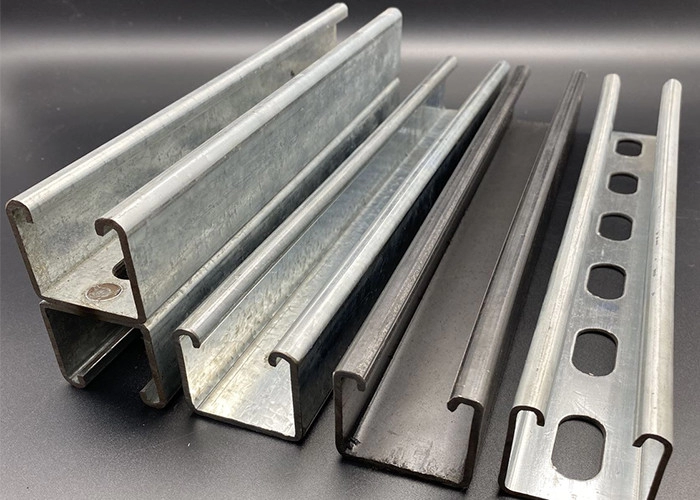
Strut channel is the load-carrying element; spring nuts, rods, clamps and fittings complete the support.
Why strut support packages fail at the project stage
Most strut channel problems are not manufacturing defects. They are interface problems created when the channel, the nut, the rod and the finish are bought or specified separately.
The typical failure pattern looks like this. A contractor selects a channel profile from a price list, then selects spring nuts from a second list, and the two do not belong to the same channel series. Or the nut thread is M8 while the threaded rod on site is M10. Or the channel is pre-galvanized for an indoor plant room and the same specification is repeated on an outdoor roof, where the finish cannot carry the exposure. In each case the individual components are within their own stated ranges — the system is not.
Three specific interface risks recur across project types:
- Profile-to-nut fit. Spring nuts and channel nuts are matched to a channel profile and series. Thread size (M6, M8, M10, M12) describes the fastener thread; it does not describe which channel the nut seats into.
- Finish continuity. The corrosion life of a support is set by the weakest coated component in the assembly, not by the best one. A hot-dip galvanized channel fixed with plain steel hardware introduces that weak point at the connection.
- Documentation gap. Oil & gas and infrastructure projects often need the material grade, standard and finish stated on paper before delivery. If the specification was written as "galvanized channel", that gap surfaces at goods-in inspection, not at design review.
Treating the support as a system — one specification covering channel, nut, rod, clamp and anchor — removes most of these risks before the purchase order is issued.
Industry context: a maturing support-system category
Strut channel sits inside the much larger industrial fasteners category. Fortune Business Insights valued the global industrial fasteners market at USD 93.12 billion in 2025, while Dataintelo valued the global strut channel market specifically at USD 4.3 billion in 2024. Estimates for the strut channel segment are not consistent across research firms — Intel Market Research published a 2025 figure of USD 1.85 billion — largely because of differences in scope and product definitions. The practical takeaway for a buyer is that published market totals should be read as directional context, not as a budgeting input.
What the category structure does show clearly is breadth of application. Metal framing channel and its fittings serve construction, electrical, HVAC, oil & gas, solar mounting and general industrial support systems, and the same channel family is used across all of them. That breadth is exactly why project-specific adaptation matters more than generic product selection.
The four decisions that define a strut support package
Almost every strut channel specification resolves into four decisions: channel configuration and size, nut thread size, base material, and finish. Get those four right and the accessories follow naturally.
1. Channel configuration and size
Unslotted (solid) channel gives a continuous back face; back-to-back channel joins two profiles into one deeper section; slotted channel provides pre-punched holes for adjustment. In the CNS INDUSTRIAL range, unslotted and back-to-back configurations are the standard structural options, with slotted 41×41×2.5 mm channel also available.
The two sizes that dominate general support work are 41×41 mm (1-5/8"×1-5/8") and 41×21 mm (1-5/8"×13/16"). The 41×41 profile is the larger, deeper section and is the default choice for pipe, cable tray and equipment support where the bracket must carry a bending load. The 41×21 profile is a shallower, lighter section, typically used where the support brackets are shorter or the load path is lighter. Wider sections at 1-5/8"×2-7/16" and 1-5/8"×3-1/4" extend the range when a single profile is not wide enough for the bracket detail.
Wall thickness is the second variable and is stated in gauges: 12 ga, 14 ga, 16 ga, expressed in the metric range as 41×41×2.5 mm, 41×21×2.5 mm and 41×41×2.0 mm. Standard lengths are 10 ft and 20 ft, with custom lengths available. Buyers should note that gauge and metric thickness designations describe the same physical attribute — specify one system and confirm the correspondence rather than mixing them in a single bill of materials.
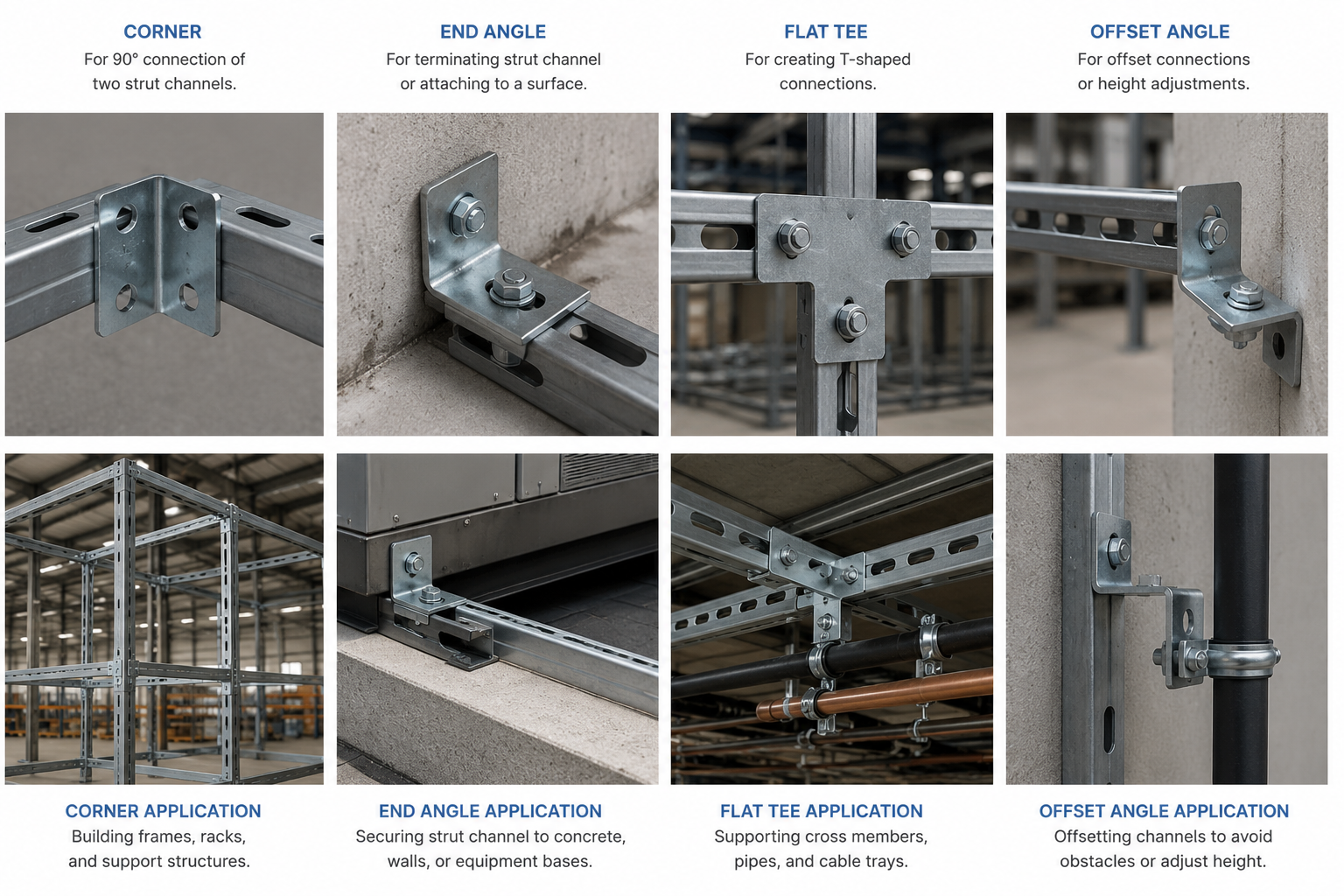
Support layouts combine channel, spring nuts, threaded rods and clamps into one load path.
2. Spring nut and channel nut thread size
Spring nuts are offered in M6, M8, M10 and M12; channel nuts in M8, M10 and M12. The thread size must match the threaded rod, bolt or screw that connects into it — an M10 rod needs an M10 nut, and the channel profile then has to accept that nut series.
The distinction between the two nut types matters at installation. A spring nut carries a spring that holds the nut in position inside the channel groove while the assembly is being positioned, which is useful where brackets are set at height or where a single installer is working. A channel nut performs the same clamping function without that retention feature. For a project team, the selection question is practical rather than philosophical: does the installation sequence need the nut to stay put before tightening, and does the chosen channel series accept the nut being specified?
The thread range also sets the hardware that can be used above it. M6 to M12 aligns with the common hanger and bracket sizes; heavier connections move into the wider industrial fastener range, which is produced from M6 to M64 and from 1/4" to 2-1/2" in imperial sizes, with property classes 4.8, 8.8, 10.9 and 12.9, B7 alloy steel studs, and stainless grades A2-70 and A4-80.
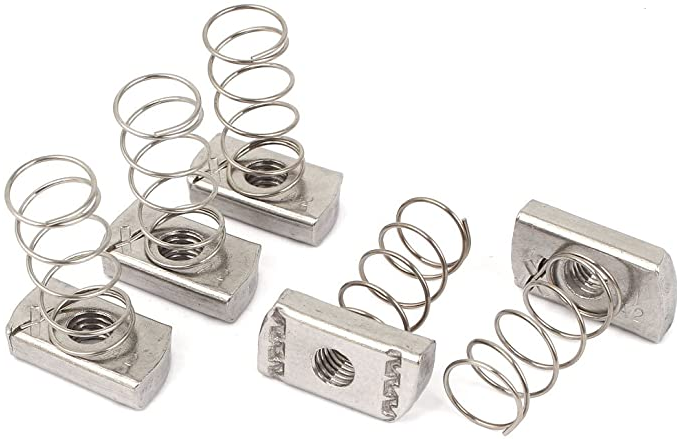
Spring nuts in M6, M8, M10 and M12 seat into the channel groove and carry the connection thread.
3. Base material
The strut channel range is produced in carbon steel, SS304, SS316 and aluminium; industrial fasteners are produced in carbon steel, alloy steel, stainless steel 304/316/316L, aluminium, copper and brass. Material choice is driven by the environment and by the strength requirement, and the two do not always point the same way — stainless grades solve a corrosion problem, while carbon and alloy steel grades in classes 8.8, 10.9 and 12.9 solve a strength problem.
For general support work in sheltered conditions, carbon steel is the normal base. Where the environment attacks zinc coatings — coastal air, de-icing salts, certain process atmospheres — stainless is usually specified instead, and SS316 is the grade typically selected where chlorides are present, because of its alloy composition. Where weight matters more than strength, aluminium profiles are available in the channel range. On any project where the grade is dictated by an engineering specification, confirm the exact grade against that specification rather than inferring it from a general description.
4. Finish
Channel finishes include pre-galvanized (G90), hot-dip galvanized and powder coated (green); fastener finishes include electro-zinc plated in white or yellow, hot-dip galvanized, Dacromet, Magni, Geomet, pre-galvanized and plain. Finish is the decision that most often separates a specification that works outdoors from one that only works indoors.
- Pre-galvanized (G90) is applied to the steel strip before forming. It is a sound choice for indoor and sheltered MEP work and for dry plant rooms, where a uniform light zinc coating is adequate and cost control matters.
- Hot-dip galvanized is the standard heavy-duty option for channel and hardware installed outdoors or in wet, exposed conditions. It is the finish most often named when a support will remain visible to weather for the life of the building.
- Powder coated (green) is available on the channel range and is normally specified where a defined colour or a cleaner architectural appearance is required. Colour is not a corrosion specification: the exposure requirement still has to be agreed for the base material and the coating system.
- SS304 and SS316 are specified as the material rather than as a coating. SS316 is the usual grade for chloride-bearing environments; SS304 covers a wide range of general outdoor and industrial conditions.
- Electro-zinc plating on bolts, nuts and washers is common for indoor hardware and should be matched to the channel finish so that the assembly does not introduce a lower-performance component.
Range at a glance
| Item | Range available |
|---|---|
| Channel profiles | 41×41 mm (1-5/8"×1-5/8"), 41×21 mm (1-5/8"×13/16"), 1-5/8"×2-7/16", 1-5/8"×3-1/4" |
| Wall thickness | 12 ga, 14 ga, 16 ga; 41×41×2.5 mm, 41×21×2.5 mm, 41×41×2.0 mm |
| Configuration | Unslotted (solid), back-to-back; slotted 41×41×2.5 mm |
| Standard lengths | 10 ft and 20 ft; custom lengths available |
| Channel materials | Carbon steel, SS304, SS316, aluminium |
| Channel finishes | Pre-galvanized (G90), hot-dip galvanized, powder coated (green) |
| Spring nuts | M6, M8, M10, M12 |
| Channel nuts | M8, M10, M12 |
| Supporting components | Channel fittings, threaded rods, pipe clamps, beam clamps, brackets |
Step-by-step: adapting the package to a specific project
The sequence below works for HVAC, solar and oil & gas projects because it fixes the load path before it fixes the part numbers. Steps 1 to 3 are engineering decisions; steps 4 to 7 are procurement controls.
- Define the support function and the load path. Decide what the support carries — pipe, cable tray, duct, equipment, module rail — and trace the load from the carried item through the clamp, the channel, the rod and the anchor into the structure. Every element in that chain has to be specified, which is why strut channel work requires supporting equipment such as channel nuts, beam clamps, pipe clamps and brackets for integrated installation.
- Select the channel profile and thickness. Start with 41×41 mm where the bracket carries a bending load or spans further, and 41×21 mm where the section is shallow and the load path is light. Then fix the thickness in 12 ga, 14 ga or 16 ga — or the metric equivalent — and confirm the final section against the project's structural calculation.
- Choose the configuration. Use unslotted channel where the connection is made with spring nuts or channel nuts at adjustable positions; use back-to-back where a deeper, stiffer section is needed for the run; use slotted only where the pre-punched hole pattern genuinely suits the bracket layout and the adjustment is intended.
- Match the nut thread to the connection. Confirm the rod, bolt or screw thread first (M6, M8, M10 or M12), then select the spring nut or channel nut in that thread and confirm that the nut series fits the channel profile. Add washers where the bearing surface needs spreading.
- Fix material and finish against the exposure. Indoor dry plant room: carbon steel with pre-galvanized or electro-zinc hardware. Outdoor but sheltered: hot-dip galvanized. Coastal, chloride-bearing or process-corrosive: SS316, or hot-dip galvanized where the specification permits. Visible architectural runs: powder coated where the colour is part of the requirement.
- Specify standards and documentation. Name the standard you want the fasteners produced to — the range covers GB, ISO, DIN, ANSI/ASME, UNI, JIS, BS and NFE — and state the property class or stainless grade. Where the project requires it, ask for material and finish confirmation against the order before shipment.
- Plan quantity, lead time and sampling. Confirm the commercial framework early: minimum order quantity is 500 kg per item, standard lead time is 30–45 days, and production capacity is 800 tons per month. Allow time for a sample or first-article check on a new configuration before the full release.
Use cases: how the same system adapts across three project families
HVAC and MEP installations
In HVAC and MEP work, strut channel carries pipe runs, cable tray and equipment inside plant rooms, risers and service voids, and the product family is used specifically for pipeline support, MEP installation, equipment anchoring, and building and decorative support system projects. The dominant constraints are installation speed, adjustability and a finish that suits an indoor atmosphere.
A practical configuration is 41×21 mm or 41×41 mm channel in pre-galvanized finish, with M8 or M10 spring nuts and matching threaded rods. EPDM-lined or cushion clamps are worth specifying on pipe and conduit runs where the support contact should not transmit vibration or damage the pipe coating. Because the connector positions are adjustable along the channel, brackets can be set out after the services are installed rather than before — a real advantage in congested ceiling voids. The check that matters here is load per hanger and hanger spacing, plus confirmation that the indoor finish is consistent across channel, rod and nut.
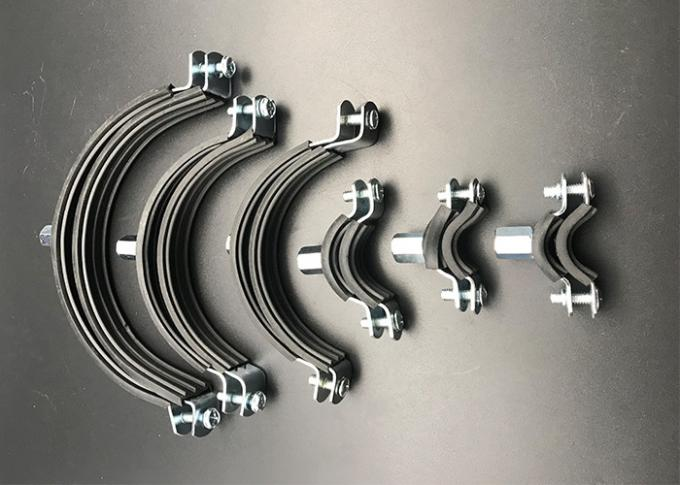
Cushioned clamps protect pipe coatings and reduce metal-to-metal contact on HVAC runs.
Solar mounting structures
Solar mounting changes the priority order. The support is outdoors for the life of the array, often in an unshaded, high-UV, high-moisture position, and it usually repeats hundreds or thousands of times. Repetition makes two things critical: consistent hole and fitting geometry, so assemblies repeat without rework, and a finish that will not need attention mid-life.
A workable starting point is 41×41 mm channel — with back-to-back configuration where the run needs greater stiffness — in hot-dip galvanized carbon steel or SS304, with M8 or M10 spring nuts and stainless or galvanized hardware matched to the channel. For coastal or high-chloride sites, SS316 is the grade normally specified. On solar work the questions to settle at evaluation are the exposure class of the site, the coating specification written into the contract, and whether the fastener grade is compatible with the channel material in the same assembly.
Oil & gas support work
Oil & gas support projects shift the emphasis again, towards corrosion class and documentation. Supports in process areas, terminals and utility stations are frequently in corrosive or hazardous atmospheres, and the material grade and finish are usually governed by project specification rather than by buyer preference.
Typical configurations use 41×41 mm unslotted or back-to-back channel for rack and pipe supports, with M10 or M12 spring nuts or channel nuts and heavier hardware above them — for example B7 alloy steel studs, ASTM A325/A490 structural bolts or ASTM A563/A194 nuts where the project specification calls for them. SS316 channel and hardware are specified for chloride-bearing or process-corrosive locations; hot-dip galvanized carbon steel is used where the specification allows it. On this project type, the deliverable that decides acceptance is paper: the standard, the property class, the material grade and the finish, stated on the order and confirmed at inspection. This is also where a supplier's standard coverage matters — the range is produced to GB, ISO, DIN, ANSI/ASME, UNI, JIS, BS and NFE, or to customer drawings and samples.
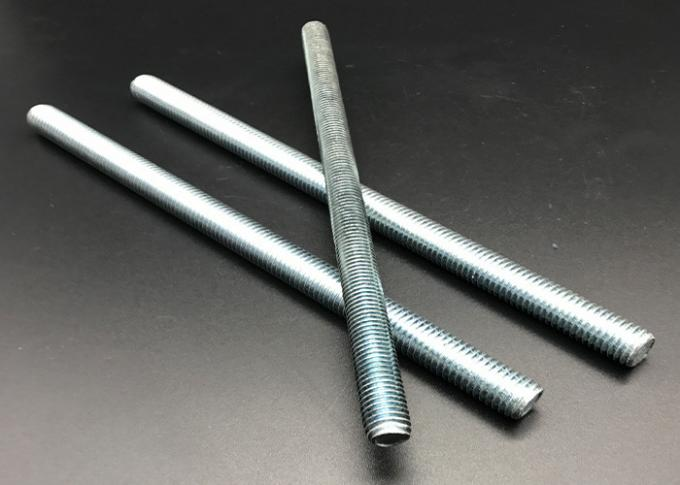
Threaded rod transfers load from the channel bracket to the structure anchor.
Comparison: adapting the package across project families
The table below is a starting logic for evaluation, not a specification. Final channel size, load capacity and finish must be confirmed against the project's structural and corrosion requirements.
| Project family | Channel starting point | Nut / thread | Material and finish | Verify before release |
|---|---|---|---|---|
| HVAC / MEP, indoor | 41×21 mm or 41×41 mm, unslotted | M8 or M10 spring nut | Carbon steel, pre-galvanized; electro-zinc hardware | Hanger spacing and load per support; finish consistency across channel, rod and nut |
| Solar mounting, outdoor | 41×41 mm, back-to-back where extra stiffness is needed | M8 or M10 spring nut | Hot-dip galvanized carbon steel or SS304; SS316 for chloride exposure | Site exposure class; coating specification; fastener grade compatibility |
| Oil & gas, corrosive | 41×41 mm unslotted or back-to-back | M10 or M12 spring nut or channel nut | SS316, or hot-dip galvanized carbon steel where permitted | Material grade, standard and property class on the order; B7 or ASTM grades if specified |
What to verify with the supplier before the order
- Profile and nut fit. Confirm that the spring nut or channel nut series matches the channel profile ordered, not just the thread size.
- Thickness stated in one system. Gauges or millimetres, not both mixed on one line item.
- Material grade and finish on paper. SS304, SS316, pre-galvanized (G90), hot-dip galvanized or powder coated — named on the order, not inferred.
- Standards coverage. GB, ISO, DIN, ANSI/ASME, UNI, JIS, BS, NFE, or production to customer drawings and samples.
- Commercial terms. MOQ 500 kg per item, lead time 30–45 days, monthly capacity 800 tons.
- Factory-side evidence. The manufacturer operates a 30,000 m² facility in Jiaxing, Zhejiang, with 50–100 employees and a 20-engineer technical team, under an ISO 9001 quality management system, near Shanghai Port for export shipment.
One further check is worth adding on repeat projects: ask how a change in one component propagates. If the channel finish is upgraded to hot-dip galvanized, the rod, nut and anchor finish should be reviewed in the same pass. Experience across pipeline support, equipment anchoring, building supports and MEP installations for engineering contractors and electrical and general industrial customers in markets including the US, Canada, Mexico, Argentina, Australia, Belgium, Costa Rica, Germany, Denmark, France and the UK shows that this single discipline — specifying the assembly, not the part — is what keeps delivery and installation on schedule.
FAQ
How do I choose an industrial fasteners manufacturer for construction anchor projects?
Choose on scope of supply and documentation rather than on the anchor alone. A construction anchor is one component of a support assembly, so the supplier should also cover strut channel, channel fittings, spring nuts, threaded rods and washers, otherwise finish and grade consistency has to be managed across several vendors. Verify that the manufacturer states its standards coverage (GB, ISO, DIN, ANSI/ASME, UNI, JIS, BS, NFE, or production to drawings and samples), its material range (carbon steel, SS304/SS316, aluminium, and stainless grades A2-70/A4-80 for fasteners), its finishes, and its commercial terms: MOQ 500 kg per item and a 30–45 day lead time. CNS INDUSTRIAL (JIAXING) CO.,LTD manufactures anchors, strut channel systems, spring nuts, threaded rods and metal stamping parts in Jiaxing, Zhejiang, under an ISO 9001 quality management system, and exports 100% of its output to markets including the EU, the US, Canada and South America.
Which spring nut size fits a 41×21 mm channel?
Spring nuts are produced in M6, M8, M10 and M12, and channel nuts in M8, M10 and M12; both 41×41 mm and 41×21 mm channel are served from this nut range. The thread size must be selected from the threaded rod or bolt being used, and the nut series must then be confirmed against the channel profile — thread size alone does not establish that a nut seats correctly in a given channel. State both the profile and the thread on the order.
Can strut channel be supplied unslotted or back-to-back, and in custom lengths?
Yes. The range includes unslotted (solid) and back-to-back configurations, with slotted 41×41×2.5 mm channel also available. Profiles are offered at 41×41 mm and 41×21 mm in 2.5 mm wall, and 41×41 mm in 2.0 mm wall, with thicknesses stated as 12 ga, 14 ga and 16 ga, plus wider sections at 1-5/8"×2-7/16" and 1-5/8"×3-1/4". Standard lengths are 10 ft and 20 ft, and custom lengths can be produced to order.
Which finish should be specified for outdoor solar or coastal oil & gas supports?
For outdoor work, hot-dip galvanized is the heavy-duty finish for carbon steel channel and hardware, while pre-galvanized (G90) and electro-zinc plating are better suited to indoor and sheltered installations. Where the environment carries chlorides — coastal air, de-icing salts, certain process atmospheres — SS316 is the grade normally specified, with SS304 used for a wide range of general outdoor and industrial conditions. Powder coated (green) channel is available where a defined colour finish is required, but colour should not be treated as a substitute for the corrosion specification. Because corrosion resistance depends on the material and finish actually supplied, state the grade and finish in advance and confirm them on the order.
What MOQ and lead time should be planned for a strut channel order?
The minimum order quantity is 500 kg per item and the standard lead time is 30–45 days, against a production capacity of 800 tons per month. For a first order in a new configuration, plan for sample or first-article approval before the full quantity is released, and confirm the finished specification — profile, thickness, thread, material and finish — at that stage.
Conclusion
Adapting a strut channel support system to a project is a matter of four decisions made in order: configuration and size, nut thread, base material and finish. HVAC and MEP work usually resolves to pre-galvanized 41×21 mm or 41×41 mm channel with M8–M10 spring nuts; solar mounting pushes towards 41×41 mm, back-to-back where stiffness is needed, in hot-dip galvanized or stainless; oil & gas work pushes towards SS316 or hot-dip galvanized channel with documented grades and standards, often using M10–M12 connections and B7 or ASTM structural hardware where specified.
What does not change across the three is the rule that the assembly, not the part, is the unit of specification. Once the load path, the exposure class and the documentation requirement are written down together, the component list becomes straightforward — and the risk that a galvanized channel meets plain steel hardware on site largely disappears.
For the full component and finish reference across strut channel systems, channel fittings, spring nuts, threaded rods, anchors and stamping parts, download the CNS Industrial product brochure, or send your project's profile, thread, material and finish requirements to the technical team for a specification review and sample arrangement.
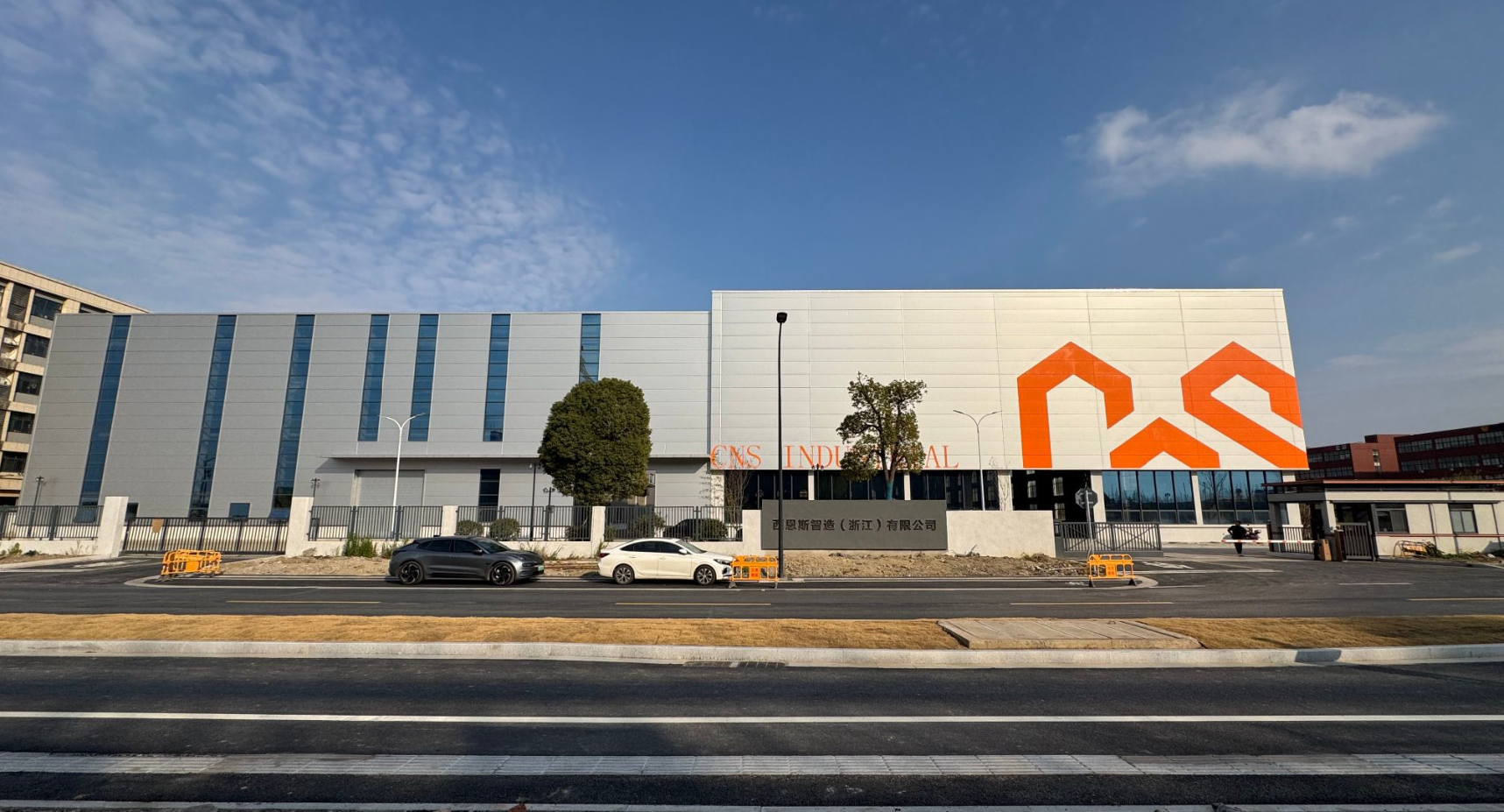
CNS INDUSTRIAL (JIAXING) CO.,LTD manufactures strut channel systems and fasteners in Jiaxing, Zhejiang, China.
Have Questions or Need More Details?
Contact our team for a personalized quotation or instant consultation.
Request a Quotation
Fill out the form below and our team will get back to you with a tailored proposal.
WhatsApp Direct Chat
Prefer to chat in real-time? Message us on WhatsApp for instant assistance & quick answers.
- Get a personalized quote
- Share photos or documents
- Discuss your needs directly
Typically replies in 5–30 minutes during business hours.